Dynamics 365 vs Salesforce: Which Implementation Fits Your Business?
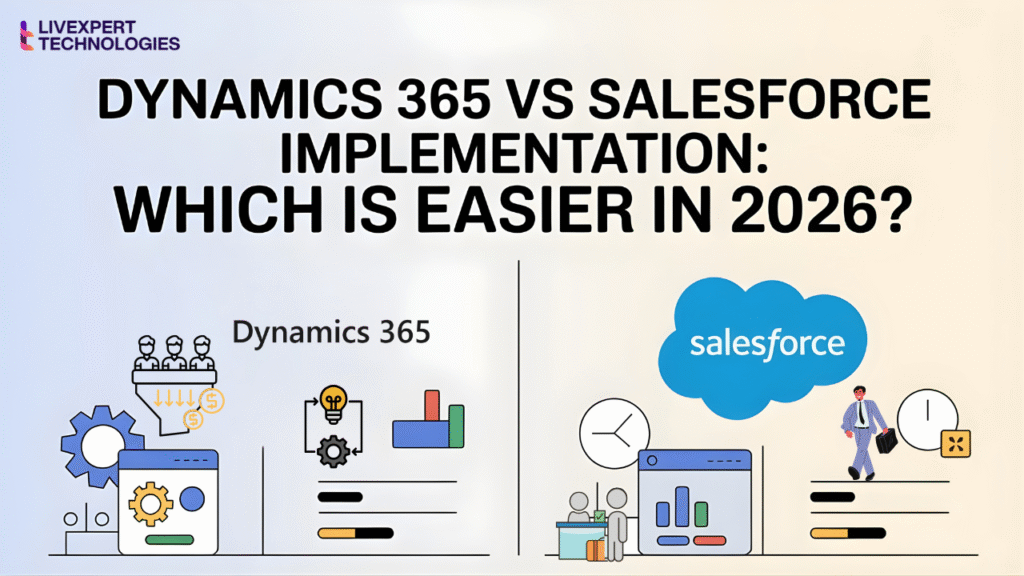
Dynamics 365 vs Salesforce Implementation: Choosing between Microsoft Dynamics 365 and Salesforce often comes down to one big question for growing businesses: Which platform is easier to implement? Both are powerful CRM ecosystems, both offer deep customization, and both dominate the global enterprise market. But the implementation experience can be very different and those differences matter.
In this guide, we break down the real-world implementation challenges, timelines, costs, integrations, and user adoption factors to help Indian enterprises decide which platform fits their growth and operational goals in 2026.
1. Setup & Onboarding Experience
Dynamics 365
More structured onboarding flow
Seamless integration with Microsoft 365, Azure, and Teams
Faster setup for businesses already in the Microsoft ecosystem
Customization requires understanding of Power Platform, but powerful once learned
Salesforce
Very flexible setup
Strong guided onboarding tools
Extensive configuration options through Salesforce Lightning
More steps needed to set up standard operations
Verdict:
Dynamics 365 is easier for companies already using Microsoft products. Salesforce offers broader flexibility but requires more upfront work.
2. Customization & Workflow Automation
Dynamics 365
Tight integration with Power Automate
Strong out-of-the-box workflows for sales, service, and finance
Customization can be simple if aligned with built-in models
Salesforce
Industry-leading customization through Salesforce Flow
Large ecosystem of apps via AppExchange
More flexible, but deeper learning curve
Verdict:
Salesforce is more flexible. Dynamics is easier for standard business workflows.
3. Data Migration Complexity
Dynamics 365
Smoother migration for structured CRM/ERP data
Native support for Excel-based imports
Data templates simplify mapping
Cleaner if migrating from Microsoft products
Salesforce
Powerful import tools
Requires more planning for relational data
Data loader enables bulk imports but needs expertise
Verdict:
Dynamics 365 offers a simpler migration process, especially for first-time CRM adopters.
4. Integration With Existing Systems
Dynamics 365
Best choice for companies using:
Outlook
Teams
SharePoint
Azure ecosystem
Microsoft ERP
Integrations are native and require minimal configuration
Salesforce
Strong integration library
Works well with third-party tools
More configuration needed for enterprise systems
Advanced integrations require middleware like MuleSoft
Verdict:
Dynamics 365 wins for native ecosystem integration. Salesforce shines for third-party flexibility.

5. User Adoption & Training
Dynamics 365
Familiar interface for Microsoft users
Easier for sales and service teams transitioning from Excel or Outlook
Faster adoption in small and mid-size businesses
Salesforce
Requires more training initially
Very configurable, which can overwhelm new users
Larger enterprises prefer its depth
Verdict:
Dynamics 365 offers faster adoption for mixed or non-technical teams.
6. Implementation Timeline
| Platform | Typical Timeline |
|---|---|
| Dynamics 365 | 4–12 weeks depending on scope |
| Salesforce | 8–16 weeks for similar complexity |
Dynamics projects move faster due to stronger native integrations and easier setup.
7. Cost of Implementation
Dynamics 365
More affordable for small and mid-size businesses
Lower consulting and customization costs
Competitive licensing pricing
Salesforce
Higher customization and consulting fees
Larger ecosystems often result in higher project spend
Verdict:
Dynamics is usually more cost-efficient, especially in India.
8. Which Platform Is Easier Overall?
Dynamics 365 is easier if:
You already use Microsoft 365
You want quicker onboarding
You need strong ERP + CRM alignment
You prefer predictable implementation costs
Salesforce is easier if:
You want a fully flexible CRM
You rely heavily on third-party systems
You need specialized workflows not covered out-of-the-box
Final Verdict:
For most growing Indian enterprises in 2026, Dynamics 365 has the simpler and more cost-effective implementation journey, especially when integrating sales, service, and ERP operations under one roof.
Exploring both platforms? Check our complete Dynamics 365 Implementation Guide for Growing Indian Enterprises.