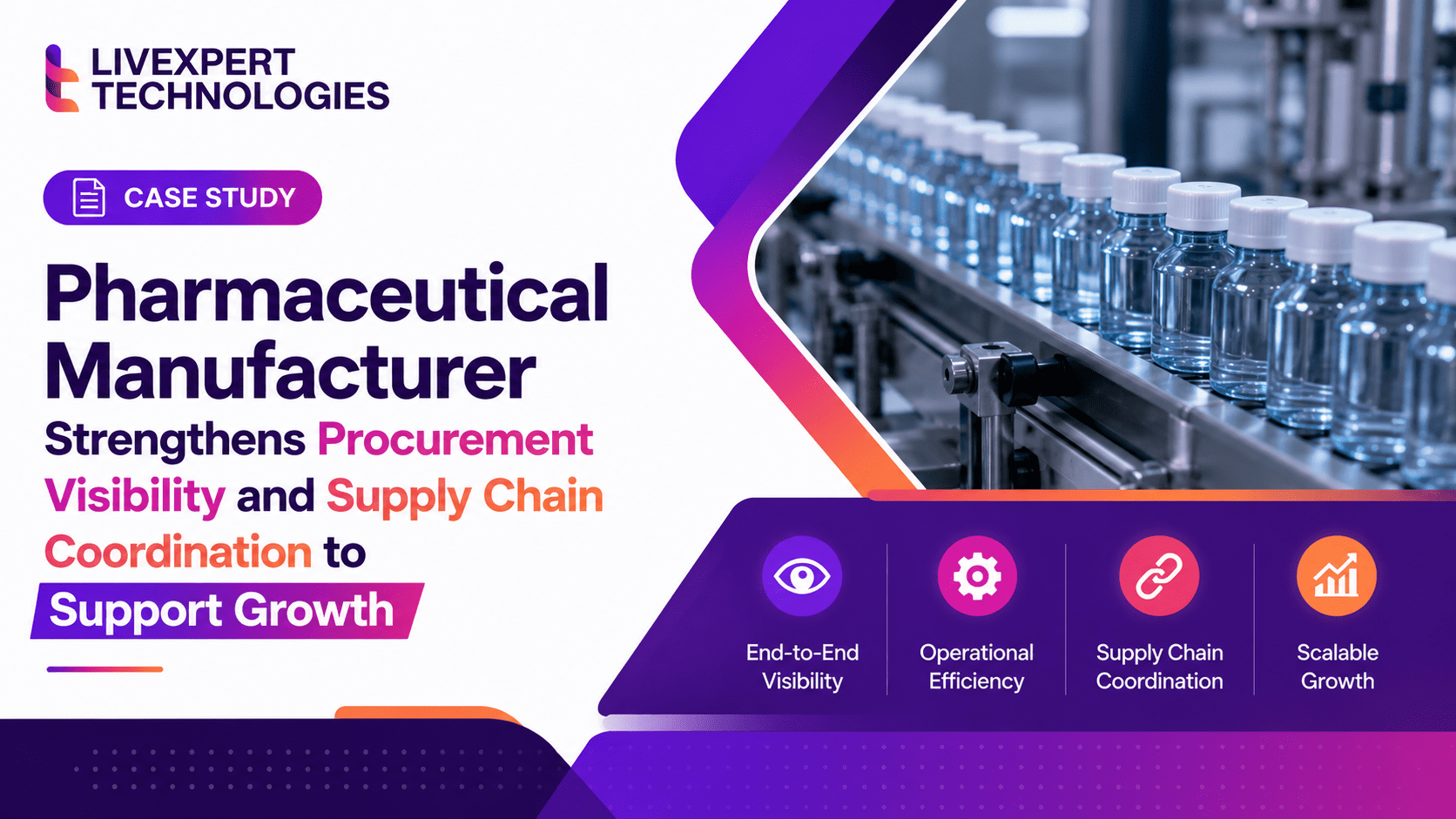
Procurement Visibility and Supply Chain Coordination to Support Growth
Business overview
A leading pharmaceutical and specialty chemicals manufacturer operating across multiple production facilities was experiencing rapid business growth while navigating an increasingly complex procurement and supply chain environment. The organization managed a broad supplier ecosystem spanning raw materials, intermediates, packaging materials, logistics partners, and indirect procurement categories. As operations expanded, leadership recognized that traditional processes and fragmented information systems were making it increasingly difficult to maintain the level of visibility, control, and responsiveness required to support future growth. The company sought to create a more connected operating model that would strengthen procurement effectiveness, improve supply chain coordination, and provide leadership with greater visibility into business performance.
The Challenge: Managing Growth in an Increasingly Complex Supply Chain Environment
Like many pharmaceutical manufacturers, the organization faced mounting pressure from multiple directions. Raw material markets were becoming increasingly volatile. Supplier performance varied across categories and geographies. Internal stakeholders expected faster procurement response times, while management required greater visibility into sourcing activities, inventory positions, and operational risks. At the same time, the business was operating through a combination of disconnected systems, manual reporting processes, and function-specific data repositories. While individual teams were able to manage their day-to-day responsibilities effectively, obtaining a consolidated view of procurement, inventory, and operational performance required significant manual effort.
Leadership identified several key challenges:
- Limited visibility into supplier performance and procurement activities.
- Inconsistent reporting across business functions and locations.
- Difficulty obtaining timely insights to support sourcing and planning decisions.
- Limited coordination between procurement, operations, inventory, and supply chain teams.
- Increasing administrative effort associated with reporting and performance monitoring.
- Challenges in establishing a single source of truth for business-critical information.
As the organization continued to grow, these limitations risked impacting operational agility, decision-making speed, and long-term scalability.
Establishing a Vision for Operational Excellence
Rather than addressing individual process issues in isolation, leadership adopted a broader transformation vision focused on operational visibility, process standardization, and cross-functional collaboration.
The objective was not simply to modernize technology infrastructure but to create a foundation capable of supporting sustainable growth while improving decision-making across the organization.
The transformation initiative was designed around four strategic priorities:
Improving Procurement Visibility
Leadership sought greater transparency into supplier performance, procurement activities, sourcing trends, and purchasing decisions.
Strengthening Supply Chain Coordination
The organization aimed to improve collaboration between procurement, planning, inventory management, manufacturing, and operations teams.
Standardizing Business Processes
A consistent approach to business processes, data structures, and reporting was required to reduce complexity and improve governance.
Enabling Data-Driven Decision Making
Management wanted faster access to reliable information that could support both operational and strategic decisions.
The Transformation Journey
The organization adopted a structured transformation approach focused on creating a more connected enterprise environment.
A significant emphasis was placed on consolidating business information from multiple systems into a unified operating framework.
Data standardization initiatives established common definitions, reporting structures, and governance practices across business functions.
Procurement, supply chain, inventory, finance, and operational teams were brought into a more collaborative operating model designed to improve visibility and reduce information silos.
At the same time, management reporting capabilities were enhanced to provide greater insight into business performance and operational trends.
By focusing on both process alignment and information visibility, the organization was able to create stronger connections between functions that had historically operated with limited transparency.
Business Outcomes
Enhanced Procurement Visibility
Procurement teams gained improved access to information related to sourcing activities, supplier interactions, purchasing trends, and operational requirements.
This increased visibility enabled more informed decision-making and improved alignment between procurement and business priorities.
Improved Supply Chain Coordination
Greater transparency across inventory, procurement, and operational activities improved collaboration between departments and reduced delays associated with fragmented information.
Teams were better positioned to respond to changing business requirements while maintaining operational continuity.
Faster Access to Business Insights
Management reporting processes were streamlined, reducing the effort required to collect, consolidate, and analyze information from multiple sources.
Decision-makers gained faster access to actionable insights that supported both day-to-day operations and long-term planning.
Stronger Governance and Process Consistency
Standardized processes and reporting structures improved operational control while reducing variability across locations and functions. The organization established a stronger foundation for compliance, governance, and future scalability.
Creating a Foundation for Future Growth
Beyond the immediate operational improvements, the transformation established a platform for continuous improvement across procurement, supply chain, and manufacturing functions.
With improved visibility, stronger collaboration, and greater access to information, leadership is now better positioned to support growth initiatives, respond to market changes, and pursue new opportunities with confidence.
The organization continues to focus on enhancing operational effectiveness, strengthening supplier relationships, and leveraging data-driven insights to support long-term business objectives.
Key Takeaway
For pharmaceutical and specialty chemical manufacturers, procurement effectiveness is increasingly influenced by visibility, collaboration, and timely access to information.
Organizations that successfully connect procurement, supply chain, inventory, and operational functions are often better positioned to improve resilience, strengthen decision-making, and support sustainable growth in an increasingly complex business environment.
Confidentiality Statement
At Livexpert Technologies, we are committed to protecting the confidentiality of our clients and partners. Accordingly, certain organization names, locations, operational details, and implementation-specific information have been anonymized or modified. The business challenges, transformation approach, and outcomes presented are representative of the engagement and the value delivered while preserving client confidentiality.