
Cloud vs On-Prem Data Warehouses: Best Fit for Indian Enterprises
The Billion-Dollar Data Dilemma Facing Indian Enterprises
In 2025, data is not just an asset for Indian enterprises; it is the new currency of power. From predicting consumer trends in Mumbai to optimizing supply chains in Chennai, the ability to store, process, and instantly analyze colossal volumes of data separates market leaders from the rest. At the heart of this capability lies a critical piece of infrastructure: the data warehouse.
Today, however, Indian business leaders are at a strategic crossroads. They face a monumental decision: should they continue to invest in traditional, company-owned on-premise data warehouses, or should they embrace the agility and scale of a cloud data warehouse in India?
This is not merely a technical choice; it is a fundamental business decision with long-term implications for cost, agility, security, and the capacity to innovate. The decision is made even more complex by the explosive growth of data, the urgent need for legacy data migration in India, and the rising demand for sophisticated enterprise BI solutions in India.
This definitive guide will dissect the cloud vs. on-premise debate specifically for the Indian context. We will explore the pros and cons of each model, analyze the critical factors of cost and performance, and reveal how expert data warehouse consulting services in India can empower you to build a data infrastructure that fuels, rather than fights, your future growth.
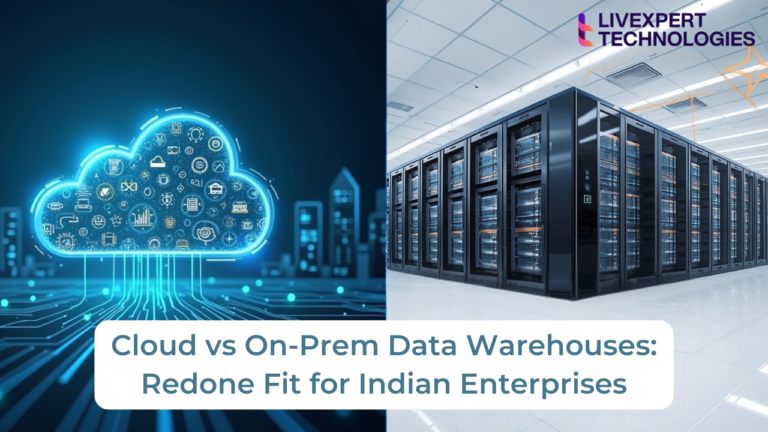
Understanding the Core Architectures: Cloud vs. On-Premise
Before diving deeper, let’s clarify the fundamental difference. Think of it like housing:
On-Premise Data Warehouses: Owning Your Own House
This is the traditional model where your enterprise purchases, houses, and manages all the necessary hardware and software in its own data center.
- Pros: Absolute control over security and data, easier compliance with strict data sovereignty rules, and predictable performance from dedicated hardware.
- Cons: Extremely high upfront capital investment, a significant maintenance burden on your IT team, and a slow, expensive process to scale capacity.
Cloud Data Warehouses: Renting a Flexible, Serviced Apartment
This is the modern approach where a third-party provider, like AWS (with Redshift), Microsoft (with Azure Synapse), or Google (with BigQuery), hosts and manages the infrastructure for you. You access it over the internet.
- Pros: Minimal upfront cost (pay-as-you-go), elastic scalability to handle any data volume, rapid deployment, and seamless integration with the latest analytics and AI tools.
- Cons: Reliance on internet connectivity, ongoing subscription costs that require optimization, and perceived complexities around data governance and compliance.
This core difference owning vs. renting is reshaping how Indian enterprises approach their data strategy, forcing a re-evaluation of agility, long-term ROI, and total cost of ownership.
Why This Debate is Critical for India in 2025
Several powerful trends are forcing this conversation into every Indian boardroom:
- The Data Deluge: The exponential growth of data from e-commerce, digital payments, healthcare tech, and IoT devices is making traditional data storage solutions prohibitively expensive and inefficient.
- The Race for Real-Time Insights: Businesses can no longer wait weeks for reports. The demand for enterprise BI solutions in India that deliver real-time dashboards and actionable intelligence is pushing the limits of legacy systems.
- Modernizing a Legacy Core: Many established enterprises are held back by aging databases. A strategic legacy data migration in India is essential for digital transformation.
- The Evolving Regulatory Landscape: Regulations like the Digital Personal Data Protection Act (DPDPA) are forcing companies to be more deliberate about data storage, security, and governance.
- Intense Cost Pressures: In a competitive market, Indian enterprises are laser-focused on shifting from high Capital Expenditures (CapEx) to a more flexible Operational Expenditure (OpEx) model.
The question has evolved from “Where do we store data?” to “Which architecture will serve as the engine for our growth and innovation for the next decade?”
For organizations looking to navigate this complex decision, expert data warehouse consulting services in India can provide a clear roadmap for a secure, cost-effective, and future-proof transition.
The Compelling Advantages of a Cloud Data Warehouse in India
1. Unmatched Scalability and Elasticity
Indian businesses, especially in retail and fintech, experience massive seasonal spikes in data. A cloud data warehouse in India allows you to scale computing and storage resources independently and instantly. This means you can handle the Diwali sales rush or month-end financial processing without any performance degradation.
2. Drastically Lower Upfront Costs (TCO)
Cloud warehouses eliminate the need for multi-crore investments in servers and hardware. By moving to an OpEx model, you pay a predictable monthly fee, preserving capital for core business functions. This makes a modern data architecture accessible even to startups and mid-sized enterprises.
3. Unprecedented Speed-to-Insight
A new on-premise environment can take months to procure and configure. In contrast, powerful cloud platforms like AWS or Azure can be provisioned in hours. This incredible speed allows your teams to start deriving value from data almost immediately.
4. A Gateway to Innovation
Cloud data warehouses are designed to integrate seamlessly with a vast ecosystem of BI platforms, machine learning frameworks, and AI tools. This makes them the perfect foundation for businesses looking to implement advanced enterprise BI solutions in India and build a data-driven culture.
5. The Power of ELT (Extract, Load, Transform)
Legacy systems use a rigid ETL process. Modern cloud warehouses use an ELT approach, where raw data is loaded first and then transformed as needed. This is far more flexible and efficient for handling the diverse, unstructured data of today.
When On-Premise Data Warehouses Still Hold Their Ground
1. Absolute Control and Data Sovereignty
For organizations in sensitive sectors, an on-premise setup provides complete physical and logical control over data. This simplifies compliance with strict data localization mandates where data absolutely cannot leave the company’s premises.
2. Optimized for Highly Predictable Workloads
If your data volumes and query patterns are extremely stable and predictable, the long-term cost of a fully paid-for on-premise system can eventually become lower than a perpetual cloud subscription.
3. Mitigating Data Gravity and Egress Costs
If your primary data sources and applications are already on-premise, keeping your warehouse there can reduce latency and avoid potentially high data transfer (egress) costs associated with moving massive datasets to the cloud.

The Big Three: A Head-to-Head Comparison
| Factor | Cloud Data Warehouse | On-Premise Data Warehouse |
| Total Cost of Ownership (TCO) | Low initial cost (OpEx). Potential for high long-term costs if not optimized. Includes compute, storage, and data transfer fees. | High initial cost (CapEx). Lower ongoing costs but includes hidden expenses like power, cooling, and IT staff. |
| Performance | Highly scalable performance. Can be tuned for specific workloads. Latency can be a factor depending on internet connectivity. | Consistent, high performance with dedicated hardware. No external network dependency for internal users. |
| Scalability | Its greatest strength. Elastic scaling of storage and compute independently in minutes. Ideal for fluctuating workloads. | Slow and expensive. Requires a lengthy process of procuring and installing new hardware, hindering agility. |
For a detailed analysis of your specific needs, from legacy data migration in India to deploying enterprise BI solutions in India, leveraging the expertise of a partner like Livexpert Technologies can ensure you make the most cost-effective choice.
The Best of Both Worlds: The Rise of Hybrid and Multi-Cloud Strategies
For a growing number of Indian enterprises, the answer isn’t a strict “either/or.” It’s about creating a balanced architecture that leverages the strengths of both models.
- Hybrid Data Warehousing: This popular strategy combines on-premise systems for sensitive, mission-critical data with a cloud data warehouse in India for analytics, BI, and disaster recovery. It offers a perfect blend of control and agility.
- Multi-Cloud Data Warehousing: To avoid vendor lock-in and optimize costs, enterprises use data warehousing solutions from multiple cloud providers (e.g., using AWS for one workload and Azure for another).
These flexible models are gaining significant traction in India, allowing businesses to tailor their data infrastructure to precise cost, compliance, and performance requirements.
Industry-Specific Recommendations for Indian Enterprises
Industry | Key Drivers & Challenges | Recommended Approach |
BFSI | Strict RBI compliance, real-time fraud detection, data sovereignty. | Hybrid-First. Keep core transactional data on-premise while leveraging the cloud for advanced analytics, risk modeling, and customer insights. |
Healthcare | Patient data privacy (DPDPA), scaling telemedicine platforms, AI in diagnostics. | Hybrid. Securely store sensitive Electronic Health Records (EHR) on-premise or in a compliant private cloud, while using the public cloud for scalable telehealth services. |
Retail & E-commerce | Massive seasonal demand spikes, omnichannel analytics, personalization engines. | Cloud-Native. The elastic scalability of the cloud is non-negotiable for handling festive sales and running sophisticated customer analytics with BI platforms. |
Manufacturing | Real-time IoT data from smart factories, supply chain visibility, predictive maintenance. | Hybrid. Use on-premise systems for low-latency operational data processing on the factory floor, and the cloud for long-term data storage and large-scale analytics. |
The Indispensable Role of Data Warehouse Consulting Services in India
Navigating this complex landscape is challenging. This is where specialized data warehouse consulting services in India become a strategic asset. An expert consultant plays a crucial role in:
- Assessment and Strategic Roadmap: Analyzing your existing infrastructure and business goals to design a clear, phased roadmap for modernization.
- Seamless Legacy Data Migration: Managing the complex process of legacy data migration in India, ensuring zero data loss and minimal business disruption.
- BI and Analytics Integration: Connecting your new data warehouse with powerful enterprise BI solutions like Tableau or Power BI to create a single source of truth for decision-making.
- Cost Optimization and Governance: Continuously monitoring your cloud usage to prevent cost overruns and establishing robust data governance models to ensure security and compliance.
Partnering with an expert de-risks the entire process and ensures your data warehouse becomes a true driver of business value.
Conclusion: Making the Right Data-Driven Decision for Your Enterprise
The cloud vs. on-premise data warehouse debate is not about choosing a superior technology; it’s about selecting the right strategy for your unique Indian enterprise.
- Cloud data warehouses are the clear choice for businesses that prioritize speed, scalability, and innovation, especially in dynamic sectors like retail, IT, and media.
- On-premise solutions retain their value for highly regulated organizations where absolute control and data sovereignty are the primary concerns.
- Hybrid and multi-cloud models are emerging as the most popular and pragmatic solution, offering a powerful balance of security, flexibility, and cost-efficiency.
Ultimately, the success of your data strategy will hinge on a well-planned implementation and continuous optimization. By engaging expert data warehouse consulting services in India, you can ensure your data infrastructure is not just a storage repository, but the engine that powers your journey to becoming a data-driven leader.
👉 Ready to build a future-ready data infrastructure? Whether you’re considering a cloud data warehouse in India, planning a legacy data migration, or implementing enterprise BI solutions, Livexpert Technologies provides the expert guidance to unlock the full potential of your data.
Frequently Asked Questions (FAQs)
A cloud data warehouse is hosted by a third party online (like AWS, Azure), offering pay-as-you-go scalability. An on-premise warehouse is physically located at your company, offering total control but requiring a large upfront investment and ongoing maintenance.
They are choosing the cloud for its unmatched scalability to handle data growth, lower initial costs (OpEx vs. CapEx), faster deployment times, and native integration with modern AI and BI analytics tools.
Not necessarily. For sectors with strict data sovereignty regulations like BFSI or defense, on-premise can still be the right choice for maintaining absolute control and simplifying compliance.
A hybrid model combines the security and control of an on-premise system for sensitive data with the scalability and analytics power of the cloud. It’s popular because it offers a balanced solution that meets both compliance and agility needs.
They are highly critical. Expert consultants provide a strategic roadmap, de-risk the complex legacy data migration process, ensure regulatory compliance, integrate powerful BI solutions, and optimize costs, maximizing the project’s ROI.
The biggest challenges include ensuring data integrity during transfer, minimizing downtime for business operations, handling diverse and unstructured legacy data formats, and ensuring the new system is secure and compliant from day one.
Retail, e-commerce, IT services, healthcare (for non-sensitive data analytics), and manufacturing are seeing massive benefits due to their large data volumes, need for real-time insights, and fluctuating demand patterns.